
Signatures: Majid Ghassemi & Mohammad Djavad Iravani; watermark: arms
© CC BY-NC
generic images
Information:
| Rarity | B - Uncommon |
| Date | Variety | Iss. | VG | F | VF | XF | AU | UNC |
|---|---|---|---|---|---|---|---|---|
| ND (1986) | Signatures: Majid Ghassemi & Mohammad Djavad Iravani; watermark: arms | + | - | - | - | - | - | - |
| Reference | P#141c |
| Country | Iran |
| Period | Second Rial (1932-date) |
| Issuing bank | Central Bank of the Islamic Republic of Iran |
| Currency | Rials |
| Denomination | 2.000 Rials |
| Type | Circulation banknotes |
| Year | 1986-2005 |
| Shape | Rectangular |
| Composition | Paper |
| Demonetized | Yes |
| Size (WxH) | 150x75 mm |
Obverse:
|
|
Latin
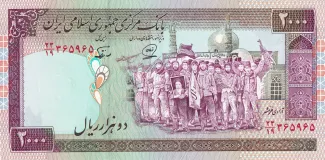
Obverse symbolPurple, olive-green and dark brown on multicolour underprint.
Revolutionists before mosque at centre right.
The Iranian Revolution; locally known as the Islamic Revolution (or the 1979 Revolution) was a series of events that culminated in the overthrow of the Pahlavi dynasty under Shah Mohammad Reza Pahlavi, and the replacement of his government with an Islamic republic under the Grand Ayatollah Ruhollah Khomeini, a leader of one of the factions in the revolt.
|
Reverse:
|
|
Latin
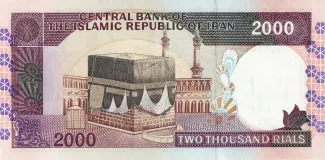
Reverse textCENTRAL BANK OF
THE ISLAMIC REPUBLIC OF IRAN
2000
2000 TWO THOUSAND RIALS
Reverse symbolThe Kaaba (Arabic: ٱلْكَعْبَة), also spelled Ka'bah or Kabah, sometimes referred to as al-Kaʿbah al-Musharrafah (Arabic: ٱلْكَعْبَة ٱلْمُشَرَّفَة), is a building at the center of Islam's most important mosque, the Masjid al-Haram in Mecca, Saudi Arabia. It is the most sacred site in Islam. It is considered by Muslims to be the Bayt Allah (Arabic: بَيْت ٱللَّٰه, lit. 'House of Allah') and is the qibla (Arabic: قِبْلَة, direction of prayer) for Muslims around the world when performing salah.
|