
Replacement;4.1.2016 to 21.6.2020; Prefix: (700/ف) to (200/ف) - Total 5 prefixes
© CC BY
generic images
Information:
| Rarity | B - Uncommon |
| Date | Variety | Iss. | VG | F | VF | XF | AU | UNC |
|---|---|---|---|---|---|---|---|---|
| ND (2016-2020) | Replacement;4.1.2016 to 21.6.2020; Prefix: (700/ف) to (200/ف) - Total 5 prefixes | + | - | - | - | - | - | - |
| Reference | P#73 |
| Country | Egypt |
| Period | Pound (1916-date) |
| Issuing bank | Central Bank of Egypt |
| Currency | Pounds |
| Denomination | 10 Pounds |
| Type | Circulation banknotes |
| Year | 2013-2025 |
| Shape | Rectangular |
| Composition | Paper |
| Demonetized | No |
| Size (WxH) | 150x70 mm |
Obverse:
|
|
Arabic
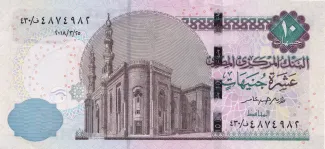
Obverse text١٠ جنيهات
البنك المركزى المصرى
عشرة جنيهات
Obverse symbolAl-Rifa'i Mosque (Arabic: مسجد الرفاعي, transliterated also as Al-Rifai, Al-Refai, Al-Refa'i, El-Refa'i, and named in English: the Refaai Mosque) is located in Midan al-Qal'a, adjacent to the Cairo Citadel. Now, it is also the royal mausoleum of Muhammad Ali's family.
The Al-Rifa'i Mosque was constructed in two phases over the period between 1869 and 1912 when it was finally completed. It was originally commissioned by Hoshiyar Qadin, the mother of the 19th century Khedive Isma'il Pasha to expand and replace the preexisting Zawiya (shrine) of the medieval Islamic saint Ahmed al-Rifa'i.
|
Reverse:
|
|
Arabic
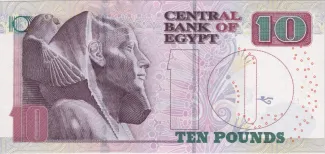
Reverse text10
CENTRAL BANK OF EGYPT
TEN POUNDS
Reverse symbolThe side view of statue of Pharaoh Khafre.
This statue, often referred to as “Khafre Enthroned,” is one of the most important and iconic surviving sculptures from ancient Egypt. It depicts the Fourth Dynasty (ca. 2500 BCE) pharaoh Khafre slightly larger-than-life and seated upon a lion-pawed throne. The sides of the throne are decorated with the sema-tawy hieroglyph, meant to represent the king’s duty to literally “bind” the constituent parts of Egypt together under one authority.
It is now located in the Egyptian Museum in Cairo. The construction is made of anorthosite gneiss (related to diorite), a valuable, extremely hard, and dark stone brought 400 miles down the Nile River from royal quarries.
|
Varieties
| Date | Variety | Iss. | Value | ||||||
|---|---|---|---|---|---|---|---|---|---|
| VG | F | VF | XF | AU | UNC | ||||
| 2013-Mar-14 | Replacement - (700/ف) | + | - | - | - | - | - | - | |
| 2013-Jun-23 | Special Replacement - (999/ف) | - | - | - | - | - | - | ||
| ND (2014-2015) | P# 73a; 18.8.2014 to 30.8.2015; Prefix(ف): 371 to 378 | - | - | - | - | - | $1,90 | ||
| ND (2015-2022) | P# 73b; 29.12.2015 to 16.8.2022; Prefix(ف) : 379 to525 | $0,35 | $0,72 | $0,92 | $1,60 | $2,10 | $2,20 | ||
| ND (2016-2019) | Special Replacement -22.9.2016 & 4.11.2018 (999/ف) - Total 2 prefixes | - | - | - | - | - | - | ||
| ND (2016-2020) | Replacement;4.1.2016 to 21.6.2020; Prefix: (700/ف) to (200/ف) - Total 5 prefixes | - | - | - | - | - | - | ||
| ND (2022) | 12.9.2022 - To date; Prefix(ف): 525- To date | - | - | $0,42 | - | - | $1,90 | ||
| ND (2022) | Replacement; 15.9-2022 to date | - | - | - | - | - | - | ||
| 2025 | Signature: HA | - | - | - | - | - | - | ||