
P#55Acs; Specimen; Signature: Dr. Atiur Rahman
© CC BY-NC
generic images
Information:
| Rarity | R - Rare |
| Date | Variety | Iss. | VG | F | VF | XF | AU | UNC |
|---|---|---|---|---|---|---|---|---|
| 2014 | P#55Acs; Specimen; Signature: Dr. Atiur Rahman | + | - | - | - | - | - | $6,20 |
| Reference | P#55Acs; |
| Country | Bangladesh |
| Period | Taka (1972-date) |
| Issuing bank | Bangladesh Bank |
| Currency | Taka |
| Denomination | 20 Taka |
| Type | Circulation banknotes |
| Year | 2012-2023 |
| Shape | Rectangular |
| Composition | Paper |
| Demonetized | No |
| Size (WxH) | 127x60 mm |
Obverse:
|
|
Bengali
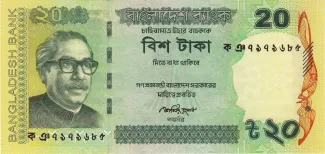
Obverse textBANGLADESH BANK
২০ বাংলাদেশ ব্যাংক 20
চাহিবামাত্র ইহার বাহককে
বিশ টাকা
দিতে বাধ্য থাকিবে
গণ প্রজাতন্ত্রী বাংলাদেশ সরকারের.
দায়িত্বে প্রবর্তিত
Obverse symbolAt Left-Portrait of Sheikh Mujibur Rahman (Bengali: শেখ মুজিবুর রহমান; 17 March 1920 – 15 August 1975), shortened as Sheikh Mujib or Mujib. He was a Bangladeshi politician and statesman. He is called the "Father of the Nation" in Bangladesh. He is considered to be the driving force behind the independence of Bangladesh. He is popularly dubbed with the title of "Bangabandhu" (Bôngobondhu "Friend of Bengal") by the people of Bangladesh.
At middle - National Martyrs' Memorial (Bengali: জাতীয় স্মৃতি সৌধ Jatiyo Sriti Soudho). It is the national monument of Bangladesh, set up in the memory of those who died in the Bangladesh War of Independence of 1971, which brought independence and separated Bangladesh from Pakistan. The monument is located in Savar, about 35 km north-west of the capital, Dhaka.
|
Reverse:
|
|
Bengali
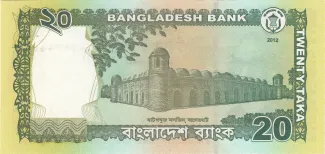
Reverse text২০
BANGLADESH BANK
TWENTY TAKA
ষাট গম্বুজ মসজিদ, বাগেরহাট
বাংলাদেশ ব্যাংক 20
Reverse symbolThe Sixty Dome Mosque (Bengali: ষাট গম্বুজ মসজিদ Shaṭ Gombuj Moshjid; more commonly known as Shait Gambuj Mosque or Saith Gunbad Masjid), is a mosque in Bangladesh. It is a part of the Mosque City of Bagerhat, a UNESCO World Heritage Site. It is the largest mosque in Bangladesh from the sultanate period (1204-1576). It was built during the Bengal Sultanate by Ulugh Khan Jahan, the governor of the Sundarbans. It has been described as "one of the most impressive Muslim monuments in the whole of the Indian subcontinent."
|
Varieties
| Date | Variety | Iss. | Value | ||||||
|---|---|---|---|---|---|---|---|---|---|
| VG | F | VF | XF | AU | UNC | ||||
| 2012 | Signature: Dr. Atiur Rahman | + | - | - | - | - | - | $0,91 | |
| 2013 | Signature: Dr. Atiur Rahman | - | - | - | - | - | $0,91 | ||
| 2014 | P#55Acs; Specimen; Signature: Dr. Atiur Rahman | - | - | - | - | - | $6,20 | ||
| 2014 | Signature: Dr. Atiur Rahman | - | - | - | $0,75 | $0,75 | $0,75 | ||
| 2015 | Signature: Dr. Atiur Rahman | - | - | - | - | - | $1,80 | ||
| 2016 | Signature: Fazle Kabir | - | - | - | - | - | $0,69 | ||
| 2017 | Signature: Fazle Kabir | - | - | - | - | - | $0,59 | ||
| 2018 | Signature: Fazle Kabir | - | - | - | - | - | $0,39 | ||
| 2019 | Signature: Fazle Kabir | - | - | - | - | - | $0,66 | ||
| 2020 | Signature: Fazle Kabir | - | - | - | - | - | $13,00 | ||
| 2021 | Signature: Fazle Kabir | - | - | - | - | - | $0,78 | ||
| 2022 | Signature: Abdur Rouf Talukder | - | - | - | $0,18 | $0,58 | $0,80 | ||
| 2023 | Signature: Abdur Rouf Talukder | - | - | - | - | - | $3,10 | ||