
Signature: Shegufta Bakth
© CC BY
generic images
Information:
| Rarity | A - Very Common |
| Date | Variety | Iss. | VG | F | VF | XF | AU | UNC |
|---|---|---|---|---|---|---|---|---|
| ND (1988) | Signature: Shegufta Bakth | + | - | - | - | - | - | - |
| Reference | P#31a(2) |
| Country | Bangladesh |
| Period | Taka (1972-date) |
| Issuing bank | Bangladesh Bank |
| Currency | Taka |
| Denomination | 100 Taka |
| Type | Circulation banknotes |
| Year | 1983-1993 |
| Shape | Rectangular |
| Composition | Paper |
| Demonetized | No |
| Size (WxH) | 158x67 mm |
Obverse:
|
|
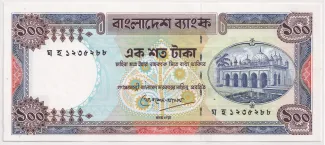
Obverse symbolAt right side - Star Mosque (Bengali: তারা মসজিদ; also known as Tara Masjid), is a mosque located in Armanitola area, Dhaka, Bangladesh. The mosque has ornate designs and is decorated with motifs of blue stars. It was built in the first half of the 19th century by Mirza Golam Pir (Mirza Ahmed Jan).
The main appeal of the mosque is the striking mosaics decorating it. The artisans who created these patterns used a technique called Chinitikri, which uses broken shards of China porcelain as mosaic pieces. (Pieces of broken bottles were also used at times because colored ceramics were costly.) The size of the pieces varied from half an inch to 2.5 inches, and the preferred shapes were rhomboid and triangular.
The mosque is now one of the few extant examples of an architectural work decorated with Chinitikri-style mosaics. Most notable is the Chinitikri blue star motif that gives the structure its popular name, Star Mosque. Hundreds of blue-colored stars adorn the white marble domes, and this star theme is echoed by the mosaics of flowers and rosettes found on the façade and the interior of the mosque.
|
Reverse:
|
|
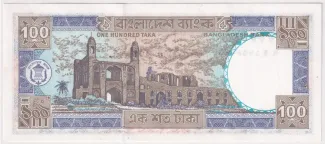
Reverse textONE HUNDRED TAKA BANGLADESH BANK
Reverse symbolRuins of Lalbagh Fort at left centre.
Lalbagh Fort (also Fort Aurangabad) is an incomplete 17th-century Mughal fort complex that stands before the Buriganga River in the southwestern part of Dhaka, Bangladesh. The construction was started in 1678 AD by Mughal Subahdar Muhammad Azam Shah, who was son of Emperor Aurangzeb and later emperor himself. His successor, Shaista Khan, did not continue the work, though he stayed in Dhaka up to 1688.
Circular toothed border added around watermark area.
|
Varieties
| Date | Variety | Iss. | Value | ||||||
|---|---|---|---|---|---|---|---|---|---|
| VG | F | VF | XF | AU | UNC | ||||
| ND (1983) | Signature: Nurul Islam | + | - | - | - | - | - | - | |
| ND (1988) | Signature: Shegufta Bakth | - | - | - | - | - | - | ||
| ND (1989-1992) | Signature: Shegufta Bakth | - | - | - | - | - | $2,00 | ||
| ND (1993) | Signature: Khorshed Alam | - | - | - | - | - | $1,70 | ||
| ND (1993-2000) | Signature: Khorshed Alam | - | - | $1,10 | $1,70 | $2,10 | $2,10 | ||
| ND (1993-2000) | Signature: Lutfor Rahman Sarker | - | - | - | - | - | $1,40 | ||
| ND (1993-2000) | Signature: Mohammed Farashuddin | - | - | - | - | - | $1,60 | ||
| ND (1993-2000) | Signature: Lutfor Rahman Sarkar | - | - | - | - | - | - | ||