
L'Aquila
Information:
| Reference | P#60 |
| Country | Italy |
| Period | Lira (1861-2001) |
| Currency | Liri |
| Denomination | 100 Liri |
| Type | Circulation banknotes |
| Ruler | Vittorio Emanuele III (1900-1946) |
| Issuing bank | Bank of Italy |
| Year | 1942-1943 |
| Shape | Rectangular |
| Composition | Paper |
| Demonetized | Yes |
| Size (WxH) | 185x116 mm |
Obverse:
|
|
Latin
Obverse textBanca D'Italia
Lire Cento
G. CAPRANESI INV.
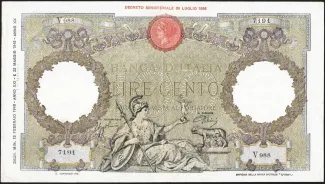
Obverse symbol🔸Designed by Giovanni Capranesi, this "𝐿𝑖𝑟𝑒 𝐶𝑒𝑛𝑡𝑜 " note features a representation of the goddess Rome on the front and a statue of the "𝐿𝑢𝑝𝑎 𝐶𝑎𝑝𝑖𝑡𝑜𝑙𝑖𝑛𝑎" suckling Romulus and Remus*.
🔸We can see the goddess Rome in military dress (armor and helmet), reclined, with her right arm resting on a shield bearing the acronym S.P.Q.R. (𝑆𝑒𝑛𝑎𝑡𝑢𝑠 𝑃𝑜𝑝𝑢𝑙𝑢𝑠𝑞𝑢𝑒 𝑅𝑜𝑚𝑎𝑛𝑢𝑠), holding a spear in the same arm, and raising a Winged Victory in her left arm.
🔸*According to the legend, Rome was founded in 753 BC by Romulus and Remus, twin sons of the god Mars and the mortal Rhea Silvia. At birth, the two brothers were abandoned by the River Tiber and rescued by a she-wolf, who suckled and protected them. Eventually, a shepherd took them in and gave them the names Romulus and Remus. During a disagreement, Romulus took Remus' life and founded Rome in 753 BC.
At the top is a red seal with an allegorical representation of Italy (𝐼𝑡𝑎𝑙𝑖𝑎 𝑡𝑢𝑟𝑟𝑖𝑡𝑎).
🔸The banknote contains two white ovals, surrounded by two oak wreaths, designed to contain the watermarks of "Italia turrita" and Dante Alighieri.
|
Reverse:
|
|
Latin
Reverse textBanca D'Italia
Lire Cento
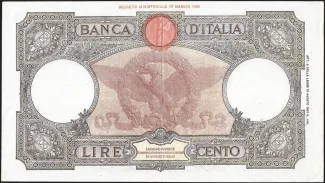
Reverse symbol🔸On the back of the banknote we see the Roman imperial eagle, surrounded by olive leaves, which was used as an insignia in the Roman Legions. When represented with two heads, the eagle symbolized the Roman Empire of the West and the Roman Empire of the East.
This symbol was widely displayed and used by Mussolini during the fascist era.
🔸Above the eagle we see a red seal with the "𝐹𝑎𝑠𝑐𝑖𝑜 𝑙𝑖𝑡𝑡𝑜𝑟𝑖𝑜", a Roman symbol originally from the Etruscans. This symbol, among others, was widely used during fascism, from which the term "𝑓𝑎𝑠𝑐𝑖𝑠𝑚𝑜" actually comes.
|
Varieties
| Date | Variety | Iss. | Value | ||||||
|---|---|---|---|---|---|---|---|---|---|
| VG | F | VF | XF | AU | UNC | ||||
| 1942-Aug-28 | (fr) Signatures : Azzolini et Urbini | + | - | - | - | - | - | - | |
| 1942-Nov-21 | (fr) Signatures : Azzolini et Urbini | - | - | - | - | - | - | ||
| 1943-Feb-13 | (fr) Signatures : Azzolini et Urbini | - | - | - | - | - | - | ||
| 1943-May-17 | (fr) Signatures : Azzolini et Urbini | - | - | - | - | - | - | ||