
The ECU: Europe’s Forgotten Pre-Euro Currency and Its Collectible Coins
· Source: Numismatic News
Before the euro, the European Currency Unit inspired a wave of commemorative and regional coin issues across the continent, many now sought by collectors.
- Unit
- European Currency Unit (ECU)
- Introduced
- March 13, 1979
- First ECU coins
- Belgium, 1987
- Key issuers
- Belgium, Netherlands, France, UK, Malta, Hungary
- Replaced by euro
- January 1, 1999 (1:1 ratio)
The European Currency Unit, or ECU, served as a precursor to the euro and sparked the creation of numerous coins and tokens across Europe from the late 1980s through the 1990s. Introduced on March 13, 1979, alongside the European Monetary System, the ECU was initially an accounting unit whose value was derived from a basket of member state currencies, weighted by economic strength.
No ECU banknotes or coins ever entered general circulation as official currency. Instead, various European nations struck ECU-denominated pieces to explore designs and specifications for a future common coinage. Many of these, particularly those produced by private entities, are now classified by the numismatic community as fantasy coins or tokens.
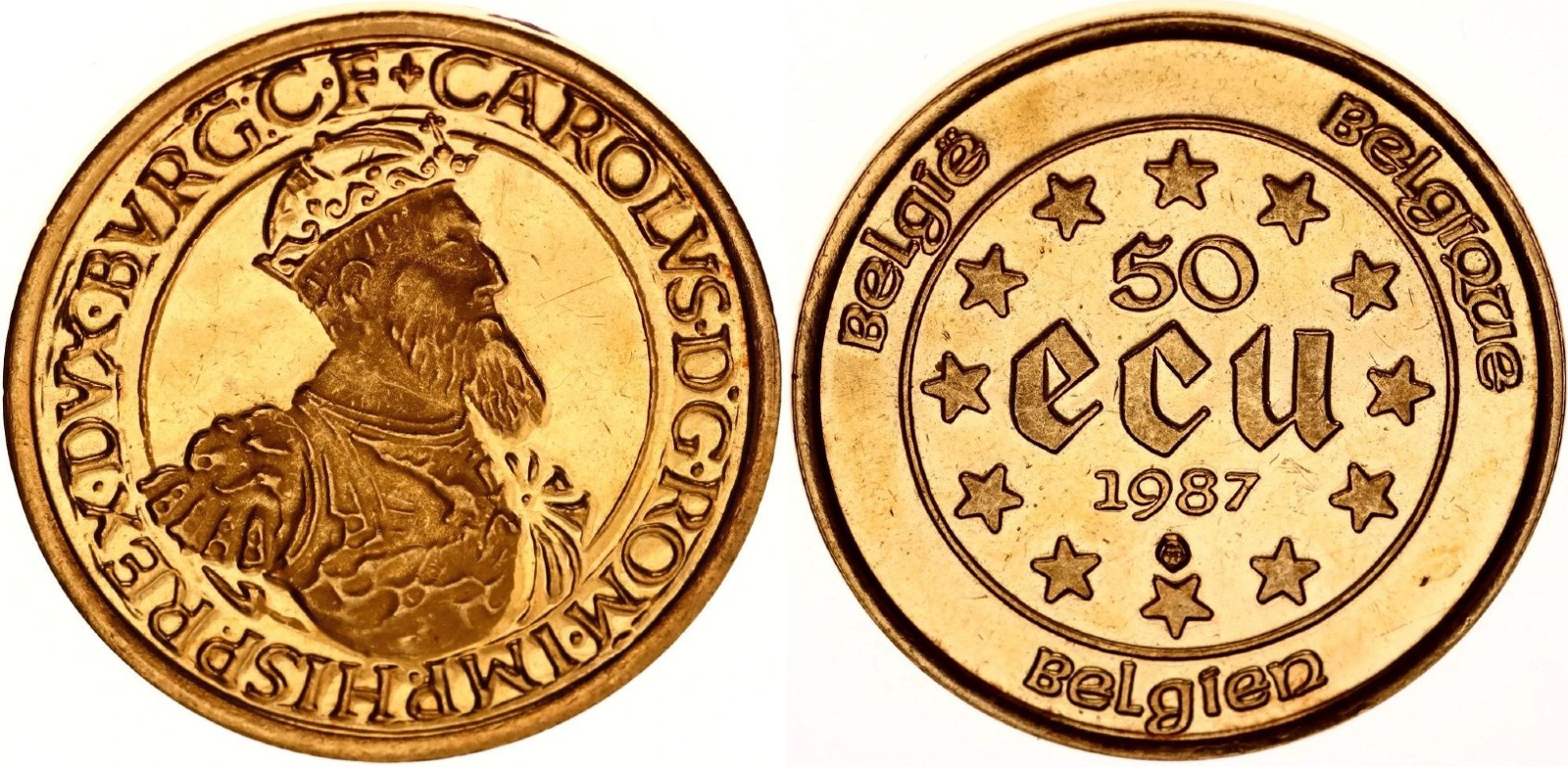
Belgium was likely the first country to mint coins bearing an ECU face value, starting in 1987 with a 50-ECU gold piece marking the 30th anniversary of the Treaty of Rome. The Netherlands followed in 1988, and Luxembourg soon after. France began issuing ECU coins in 1990, commemorating the 1190th anniversary of Charlemagne’s coronation with a 500 francs/70 ECU gold coin. Other nations, including Denmark, Greece, Portugal, and Spain, later produced their own ECU-themed issues covering a variety of topics.
Issuance extended beyond the initial nine member states. Countries outside the agreement, such as Austria, Liechtenstein, Finland, and Norway, also struck commemorative ECU coins. Malta produced a 25 lira/25 ECU gold piece in 1993. Former Eastern Bloc nations like Albania, Bosnia and Herzegovina, Hungary, and Poland created coins celebrating European integration. The United Kingdom, despite its opposition to replacing the pound, minted 25-ECU coins from 1992, with similar pieces known from the Isle of Man and Gibraltar.
Designs and denominations varied widely due to the absence of a unified regulation. Fractional values appeared as fractions, decimals, or the term “CENTECU.” Some coins had strictly local circulation, authorized for short periods in places like the French towns of Cahors or Carcassonne in 1992. Fictitious banknotes also appeared, such as 10-ECU notes printed in Munich for the 1992 Seville Expo.
The ECU’s name drew criticism. The United Kingdom objected to its association with the medieval French écu, while Germany noted that “one ECU” sounded like "eine Kuh" (one cow). The name "euro" was adopted by EU states on December 16, 1995, and the new currency entered into force on January 1, 1999, at a 1:1 ratio with the ECU. Euro coins and notes entered circulation three years later. In 2019, Belgium issued a 2-euro commemorative coin honoring the European Monetary Institute, featuring its first president alongside depictions of ECU and euro coins.